Showing posts with label Family Travel. Show all posts

Football Soccer in Buenos Aires - Calendar of matches 2026


The fixture of matches in the local 1st Division futbol championship to be played in Buenos Aires on the first half of the year 2026 has been announced.

Don't miss the opportunity of attending one of these exciting games the easiest and safest way, with a service that includes tickets, transfers, and permanent bilingual host, provided the leading companies in football tours. Contact me and make your reservation!

Ask for matches in the Campeonato Carioca in Rio de Janeiro as well!

FIXTURE

JANUARY 2026
Friday 23: San Lorenzo vs Lanus
Friday 23: Independiente vs Estudiantes de La Plata
Saturday 24: Gimnasia de La Plata vs Racing Club
Sunday 25: Argentinos Juniors vs Sarmiento
Sunday 25: Boca Juniors vs Deportivo Riestra
Tuesday 27: Velez Sarsfield vs Talleres
Tuesday 27: Huracan vs Independiente Rivadavia
Wednesday 28: Estudiantes de La Plata vs Boca Juniors
Wednesday 28: Racing Club vs Rosario Central
Wednesday 28: River Plate vs Gimnasia de La Plata
Saturday 31: San Lorenzo vs Central Cordoba
Saturday 31: Independiente vs Velez Sarsfield

FEBRUARY 2026
Sunday 1: Boca Juniors vs Newell's Old Boys
Monday 2: Gimnasia de La Plata vs Aldosivi
Monday 2: Argentinos Juniors vs Belgrano
Saturday 7: Racing Club vs Argentinos Juniors
Saturday 7: River Plate vs Tigre
Sunday 8: Velez Sarsfield vs Boca Juniors
Sunday 8: Huracan vs San Lorenzo
Monday 9: Estudiantes de La Plata vs Deportivo Riestra
Thursday 12: Argentinos Juniors vs River Plate
Friday 13: Independiente vs Lanus
Saturday 14: Huracan vs Sarmiento
Monday 15: Boca Juniors vs Platense
Thursday 19: San Lorenzo vs Estudiantes De Río Cuarto
Friday 20: Boca Juniors vs Racing Club
Friday 20: Estudiantes Lp vs Sarmiento
Sunday 22: Velez Sarsfield vs River Plate
Sunday 22: Argentinos Juniors vs Lanus
Tuesday 24: San Lorenzo vs Instituto de Córdoba
Wednesday 25: Velez Sarsfield vs Deportivo Riestra
Wednesday 25: Gimnasia de La Plata vs Rosario Central
Thursday 26:  Racing Club vs Independiente de Rivadavia
Thursday 26: River Plate vs Banfield
Saturday 28: Independiente vs Central Cordoba
Saturday 28: Boca Juniors vs Gimnasia de Mendoza

MARCH 2026
Sunday 1: Argentinos Juniors vs Barracas Central
Monday 2: Estudiantes de La Plata vs Velez Sarsfield
Tuesday 3: Huracan vs Belgrano
Friday 6: Velez Sarsfield vs Newells Old Boys
Saturday 7: San Lorenzo vs Independiente
Saturday 7: Racing Club vs Huracan
Sunday 8: River Plate vs Atlético Tucuman
Sunday 8: Gimnasia de La Plata vs Argentinos Juniors
Tuesday 10: Independiente vs Union
Wednesday 11: Boca Juniors vs San Lorenzo
Wednesday 11: Argentinos Juniors vs Rosario Central
Thursday 12: Huracan vs River Plate
Friday 13: Estudiantes de La Plata vs Lanus
Sunday 15: Gimnasia de La Plata vs Independiente Rivadavia
Sunday 15: River Plate vs Sarmiento
Monday 16: San Lorenzo vs Defensa Y Justicia
Monday 16: Racing Club vs Estudiantes De Río Cuarto
Saturday 21: Velez Sarsfield vs Lanus
Saturday 21: Independiente vs Talleres
Monday 22: Boca Juniors vs Instituto de Cordoba
Tuesday 23: Estudiantes de La Plata vs Central Cordoba
Tuesday 23: Huracan vs Barracas Central

APRIL 2026
Sunday 5: San Lorenzo vs Estudiantes de La Plata
Sunday 5: River Plate vs Belgrano
Sunday 5: Gimnasia de La Plata vs Huracan
Sunday 5: Independiente vs Racing Club
Sunday 5: Argentinos Juniors vs Platense
Sunday 12: Velez Sarsfield vs Central Cordoba
Sunday 12: Estudiantes de La Plata vs Union
Sunday 12: Huracan vs Rosario Central
Sunday 12: Racing Club vs River Plate
Sunday 19: Independiente vs Defensa Y Justicia
Sunday 19: San Lorenzo vs Velez Sarsfield
Sunday 19: Gimnasia de La Plata vs Estudiantes De Río Cuarto
Sunday 19: Argentinos Juniors vs Atlético Tucuman
Sunday 19: River Plate vs Boca Juniors
Sunday 26: Velez Sarsfield vs Union
Sunday 26: Estudiantes de La Plata vs Talleres
Sunday 26: Huracan vs Argentinos Juniors
Sunday 26: Racing Club vs Barracas Central
Sunday 26: River Plate vs Aldosivi

Schedule subject to change of dates and addition of new matches depending on the progress of the tournaments, please check regularly for updates.

Contact me and make your reservation!

Teatro Colon Guided Tours


After more than two years being suspended because of the pandemic, the guided tours to the interior of the magnificent Teatro Colon of Buenos Aires start running again on April 21st, 2022.

The tours are held every day of the year, including weekends and holidays (except May 1st, December 24th, 25th and 31st, and January 1st).
The guided visits have a duration of approximately 50 minutes, starting at Paseo de los Carruajes, on Tucuman 1171.
Tours are offered every 15 minutes from 10:00 AM to 4.45 PM. 
Guided visits in English are conducted every day at 10:00 AM, 11.00 AM, 12.00PM, 1:30 PM, 3.00 PM, and 4:00 PM.

The visit has a cost of $ 22,000 Argentine Pesos for foreign visitors.
Argentine residents (with DNI): $10,000 Pesos
Retirees, resident university students (1) and Cultural Pass: $4,500 Pesos
Children under 7 years old (2): Free of charge
People with a disability certificate and one companion (3): Free of charge

1. Tickets corresponding to the “Retirees” and “Students” rates may be purchased by credit or debit card only at the Teatro Colón Ticket Office upon presentation of official documentation proving that status.

2. Tickets for minors, free of charge, must be exchanged for the same method in which the paid tickets were purchased (website or in-person ticket office).

3. Discounts are only applied to the Ticket Office upon presentation of the corresponding credential or certificate.

The entrance ticket can be acquired at the Theater's box office (Tucuman 1171), with credit card, debit card, or cash (Pesos), or online through this link.

For more information, visit the Teatro Colon website,


Visiting Buenos Aires with kids


Buenos Aires is a child friendly city and there many things to do every day of the year. Here are some recommendations on what to do with small kids in the city.

RESTAURANTS:

Except for very fancy restaurants, most restaurants in Buenos Aires welcome children. Argentine families use to eat out very often, even until the very late hours of the night. Many restaurants offer kid's menus (“menu infantil”) at a fixed price, that usually include pasta, or the traditional “milanesa con papas fritas” (breaded meat with French fries), which is Argentine children´s favorite dish.

OUTINGS: 

Japanese Garden: This is a great place for children and adults alike. There´s a playground for children, and they will have the chance to feed the koy fish in the ponds, with the fish food sold at the kiosks. More info>>

Plaza Francia, Recoleta: On weekends, there are free performances for children in the park, like clowns, magicians, or puppet shows. At the crafts fair there are lots of hand-made toys on sale: puppets, wooden puzzles, mobiles, musical instruments, as well as dolls, jewelry, bags, scarves, for girls of all ages.

Ecological reserve: located at Puerto Madero neighborhood, this is a protected piece of land by the river, where you will have the chance to see some wild animals at their natural habitat, like otters, turtles, and many kinds of birds. There are also bicycles for rent at the entrance of the park. More info>>.

Eco Parque Buenos Aires: this is the former Buenos Aires Zoo, that has been transformed in an ecological park. It is open from Tuesday to Sunday and Holidays, from 11.00 am to 6:00 pm, with free entrance for all the public, but some axhibitions require entrance fee payment.
Access through Av. Santa Fe & Sarmiento. More info>>

Frigate President Sarmiento and Corvette Uruguay (photo below): These two old navy vessels, anchored at Puerto Madero, were the training ships of Argentine navy. They both contain a navy museum each, and old navy artifacts. 
They can be visited Thursday & Friday, 1:00 PM to 9:00 PM. Saturday & Sunday, 10:00 AM to 7:00 PM


MUSEUMS:

Museo Participativo de Ciencias: Located at Recoleta Cultural Center, the motto of this science museum is “Forbidden NOT to touch”. Ideal for children between 5 and 10 years of age.
Opening times:
Tuesday to Friday: 10:00 am to 4:00 pm.
Saturday & Sunday: 3:00 pm to 8:00 pm

Natural History Museum: The highlights of this museum are the giant dinosaurs in exhibition. There's also a very nice aquarium. More info>>


Children´s Museum "Museo de los Niños Abasto": Located at Abasto Shopping mall, this is an interactive museum for small children (ideally 2 - 6), where kids can participate in city life activities, such as a TV station, a supermarket, bank, doctor's office, construction site, fast food restaurant, and many others. More info>>
You can also find a big playground and arcade with electronic games for children, bumping cars, little trains, and even a giant at Abasto Shopping Mall.

Planetarium Galileo Galilei: The Planetarium is the main astronomy dissemination center in the city. It has a hemispherical projection room with 360 reclining seats and a dome twenty meters in diameter where nearly 8,900 stars, planets and satellites of the universe are reproduced, thanks to an impressive equipment (unique in Latin America), which means that the dome contains 38 million pixels.
Its five-story building also has a museum and a small secondary projection room, in addition to housing a collection of meteorites from northern Argentina.More info >>

BOOK STORES:

The children´s section of bookstores like Yenny or Cuspide allow children to touch and pick all the books they want. There´s a good selection of books in English and Spanish. While children are playing, parents can have a coffee while reading a book as well.

CHILDREN'S SHOWS:

Especially during school winter holidays (late July - early August), there is a great offer of theater shows for kids. They are in Spanish of course, but some of them are musical shows that can be enjoyed even without knowing the language.

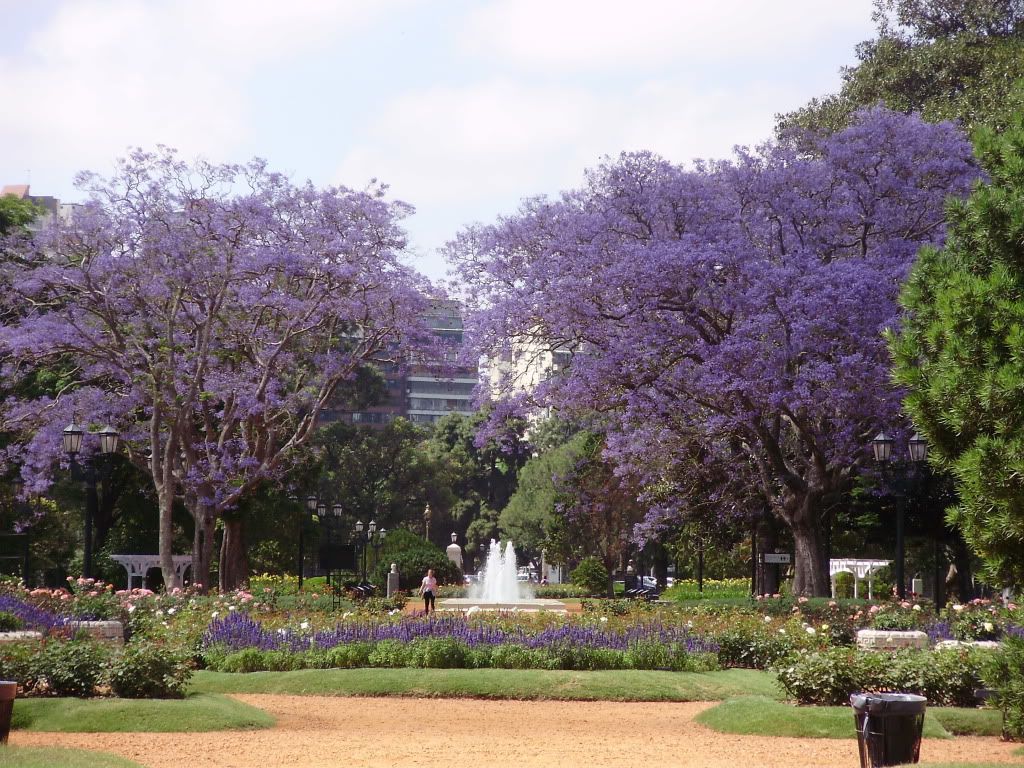
Buenos Aires Rose Garden - El Rosedal


The Rose Garden (El Rosedal), surrounded by Infanta Isabel, Iraola and Pres. P. Montt avenues, and protected all around by an iron gate, is the heart of the Tres de Febrero park. It was created in 1914 by the landscaper Carlos Thays.


The main attractions inside the park are:

° The Andalusian Patio: built in 1929 and given away by the city of Seville, Spain.
° The Arbor (La Pergola), covered with climbing rose bushes:
° The White Bridge, a magnificent construction of wood built over the lake after a design by architect Benito Carrasco in 1914
° The Poet's Garden, with busts in honor to poets from different countries, like William Shakespeare, Alfonsina Storni, Dante Alighieri, Federico García Lorca, Antonio Machado and Jorge Luis Borges, among others.
° The artificial lake, with its wooden piers, bridges and amphitheater:
° The Rose Garden itself, in the heart of the park, with its many flower beds which are home to over 12,000 rose bushes of different kinds.

The area around the Rose Garden and its lake is one of the preferred places in the city for open air activities, especially on weekends when it's also possible to enjoy live music, free gym classes, street performers. At the lake, you can hire boats with paddles or pedals. Around the lake, the pedestrian streets are perfect for roller blading, cycling, jogging, or just walking for taking in some fresh air and enjoying nature:

Location: near Av. del Libertador and Av. Sarmiento 
Opening times:
Summer: Tuesday to Sundays, from 8 am to 8 pm
Winter: 9 am to 6 pm
MONDAYS CLOSED

A visit to the magnificent Palacio Paz


Palacio Paz, located in the heart of the city opposite Plaza San Martin (Av. Sante Fe 750) is an imposing building which fronts, sculptures and ornaments are copies or inspired on several French palaces, and one of the best examples of the French Architecture in Buenos Aires.
The palace's architect, Louis Marie Henry Sortais was French, studied at the Ecole des Beaux Arts in Paris and won the Grand Prix de Rome in 1890. The owner of the residence, José C. Paz, was ambassador to France in the late nineteenth century. Palacio Paz is also the work of the Argentinian architect and engineer Carlos Agote, since Sortais never traveled to Argentina, and in fact died in 1911, leaving Agote in charge of construction management when works were still not complete.
The construction was carried out between 1902 and 1914. Two years before the inauguration of the palace Dr. José C Paz died in Monaco, for which he never had the chance to live in it, but his wife and children did.
Palacio Paz was, at the time of its construction, the largest private residence in the city, with its 140 rooms, 40 bathrooms and 12,000 square meters of covered area.
José Camilo Paz, the ideologist of this masion, brought from Europe all the pieces for the construction and decoration of the palace: marbles, iron works, chandeliers, ornaments, furniture, flooring and lights, among many other things, including the huge four-door iron gate that serves as entrance to the palace.
It is believed that Paz had presidential aspirations. He thought that the palace could become the official presidential residence.
The building consists of three wings and a large internal garden. The main facade resembles the typical French castles. The model used for the overall composition of the palace was the Chantilly Castle, rebuilt by Honoré Daumet, Sortais' teacher. The set of rooms on the main floor appears as an eclectic showcase of French historical styles. The Grand Gallery of Honor and the main dining room are inspired on the French Renaissance. The Ballroom on the other hand is Regency style. In other smaller rooms we find Louis XVI and Empire styles. 
The great honor gallery leas to the Great Hall of Honor, the most impressive room in the Palace, a Circular hall of imposing dimensions and crowned with a towering dome.


Palacio Paz is currently the headquarters of the Military Circle in the City of Buenos Aires, and is one of the few magnificent French buildings that are opened to the public and still preserve the grandeur of the time.
There's also a nice café in the interior courtyard (Croque Madame) and a restaurant  in one of the interior rooms, open to the general public.

The interior Palace can be accessed by Guided Visits only (with a cost), on Tuesdays, Thursdays and Saturdays, with previous reservation via email to reservaspalaciopaz@gmail.com

See more pictures of Palacio Paz on our Facebook album.

Mataderos Fair - A showcase of Argentine traditions


Since 1986, the Fair of Crafts and Popular Argentinian Traditions, better known as the Mataderos Fair (Feria de Mataderos), is open to the public on Sundays and National Holidays from 11 am to 7 pm in its winter schedule from March through December.

At the Mataderos Fair visitors can enjoy more than 500 traditional craft stalls from around the country and about 40 stalls of local products and food characteristic of our country: locro, humita, empanadas, tamales, asado, "choripan", tortas fritas.

As usual, gaucho skills as the Corrida de Sortijas, the traditional game of Pato (horse ball) are held every Sunday afternoon, as well as traditional parades of floats, the Gauchos Parades, and recreational activities for the whole family, like the Children's Film Club, and over 15 free workshops: Folk dance, Loom, Guitar, Charango, Sikus, Tango, wood carving, Quichua Language, Basketry, Ceramics, etc.

During the year many renowned artists are presented in the main stage, as well as folk music and dance groups that always accompany the Fair, many of which travel specially from various provinces of our country to be at the Fair, a wonderful opportunity to showcase their music.

Throughout the year several special events are held, with a prominent priority for National Holidays: May 25th (May Revolution), July 9th (Independence Day), October 12th  (Reaffirmation of the rights of indigenous peoples), November 10th  (Tradition Day), and in the month of June the celebration of the Mataderos Fair's birthday.


Feria de Mataderos. 
Location: Av. Lisandro de la Torre and Avenida de los Corrales
Opening Hours: Sundays and National Holidays, 11 am to 7 pm.
Closed in case of rain

Anne Frank House in Argentina


The Anne Frank House in Argentina was inaugurated on June 12, 2009, the day of her 80th birthday. It is located in Superi 2647, in the neighborhood of Belgrano, being the first institution member of the Anne Frank House in Latin America.
The house features an exact reproduction of the rooms in the original hiding place in Amsterdam where Anne Frank and other seven people went into hiding from the Nazis for more than two years, including the movable bookcase that served as entrance to the Secret Annex of the house, the kitchen, the bathroom, the living room, and Anne's complete bedroom, as well as a reproduction of her famous diary.
There's also a "Free2Choose" room, with an interactive film screening, made by the Anne Frank House in Amsterdam, in which film clips are used to invite visitors to think about issues concerning human rights and freedoms.
The House offers guided visits, workshops and seminars aimed to educators, students and members of defense institutions.

Opening hoursThursday, Friday, Saturday and Sunday, 2 PM to 7 PM.
Admission: Guided tour through four exhibition rooms, original objects from Frank family, the only recreation of the House and the original chesnut tree Ana Frank wrote to in her diary: 
General: AR$8000.-
Students and Seniors: AR$6500.-
On sale at the door. 

For more information on present and future exhibitions, visit Centro Ana Frank official website.

A peaceful retreat: the Botanical Garden of Buenos Aires


The history of the Botanical Garden of Buenos Aires dates back to 1898, when the then Director of Public Parks of Buenos Aires, the French landscaper Charles Thays, proposed the creation of a Botanical Garden in the terrains it occupies today, bounded by Santa Fe Ave., Las Heras Ave. and Republica Arabe Siria St., for educational and conservation purposes.

The red brick English style building that already existed in those terrains was occupied by Charles Thays and his family. Today this building, that was declared National Monument, is the main building of the complex and serves as an art gallery and exhibition hall. There is also a Gardening School, a Library, and several greenhouses. The main greenhouse in Art Nouveau style, received a prize in the Paris Universal Exhibition of 1889.


There are more than five thousand species of plants and trees from all over the world, from Asia to Africa to America. There are small examples of three different styles of gardens: a French Garden, a Roman Garden, and a Japanese Garden.

As you walk the trails of the garden, you will find some beautiful marble sculptures, such as “Spring”, “Mercury”, “Venus”, and the group representing the movements of the VI Symphony of Beethoven, called “La Pastoral”. There is also a monument entitled “Weather Indicator”, designed by José Markovich, and presented by the Austro-Hungarian Empire community.

This garden is so peaceful that once you cross the gates and get inside, you instantly forget that you are in the middle of the city and surrounded by two of the noisiest streets in Buenos Aires.

Address: Santa Fe and Las Heras Ave., Plaza Italia. Subte station: Plaza Italia, Line D.

Opening Times: 
Summer (September 22nd to April 21st): Tuesday to Friday, 8 am to 6:30 pm - Saturdays, Sundays and National Holidays: 9.30 am to 6:30 pm.
Winter (April 22nd to September 21st): Tuesday to Friday, 8 am to 5:30 pm - Saturdays, Sundays and National Holidays: 9.30 a m to 5:30 pm.
MONDAYS CLOSED
January 1st, Good Friday, May 1st, September 21st, and December 25th: CLOSED
On days of extremely bad weather (intense winds, persistent rain) the garden will remain closed for safety reasons.

FREE ENTRANCE

For more pictures of the Botanical Garden, visit my Botanical Garden Photo Gallery on Facebook.

Japanese Garden of Buenos Aires


In a corner of the large Parque Tres de Febrero, on Av Casares and Av Figueroa Alcorta, lays the Japanese Garden of Buenos Aires, an oasis in the middle of the city. In 1967, the city government lent this piece of land to the Japanese immigrants in Buenos Aires, who in return made this beautiful garden for all the inhabitants of the city.

Its ponds are filled with large koi fish, which can be fed with the koi food sold at the kiosks, making this a perfect place to visit with small children.


The tranquility of the place also invites to seat and relax in one of the many benches dispersed around the ponds. It is also a nice place to read a book or just contemplate nature. There are many species of trees and plants from Japan and the rest of the world, identified with their name tags.

The park is beautiful all year round, but the best time to visit is in early spring (September-October), when the multicolored azaleas are in full bloom.


There´s also a tea house and restaurant, which serves some of the best sushi and Japanese dishes in Buenos Aires, with the magnificent view of the gardens.

Location: Av. Figueroa Alcorta & Casares
Open every day from 10 AM to 6.45 PM
Entry fees:
Non-Argentine Adults: AR$ 13500.-
Children under 12: free
More information: Japanese Garden of Buenos Aires official website.